

News & Blogs
What Happens When Learning Experiences Connect
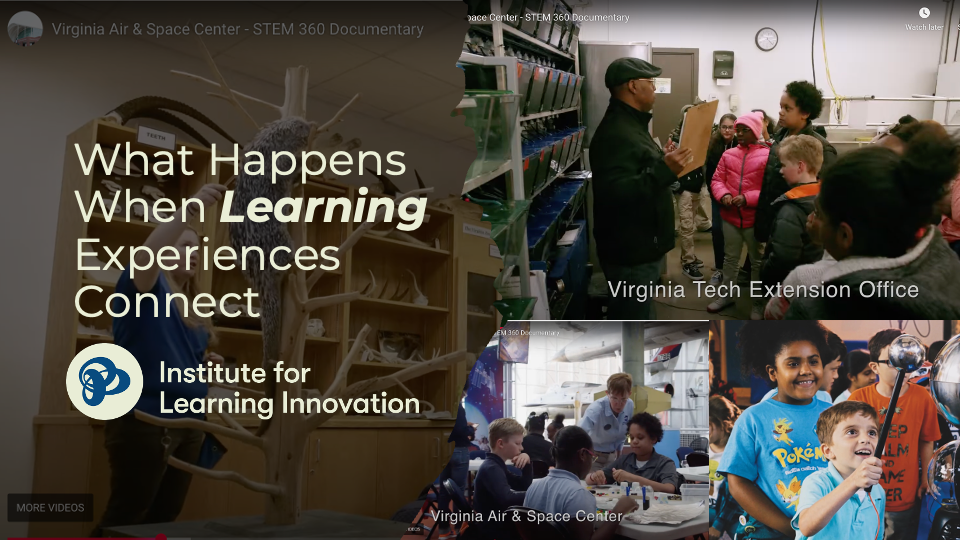
When learning experiences connect across different contexts and over time, we see deeper engagement, stronger learning, and new possibilities for young people. We have seen this time and again with STEM engagement. That building connections across schools, community organizations, and science learning institutions helps young people make connections that can open them up to new possibilities.
Marcus had never thought of himself as a science kid. It just wasn’t something that had clicked for him… until the space unit. It started in class with a career workshop where students took on the roles of different space professionals. Then the class visited the Virginia Air and Space Science Center, watched an IMAX film about astronaut training, and explored hands-on exhibits. Back at school, an outreach lesson on the solar system pulled it all together. Each experience built on the last.
Marcus started researching space on his own. He told his teacher he wanted to do engineering for NASA. When she reflected on what had changed, she didn’t point to any single moment:
” I think the combination of the lesson that was here at school, and then seeing the movie of how the astronauts are trained and prepare themselves to go into space, and then we were at [the Virginia Air and Space Science Center] … It was just a whole new world outside of what you know around you. I think that was really helpful for them to learn and then actually physically get to see what they were learning.”
What happened for Marcus wasn’t just increased exposure. It was what happens when learning experiences are intentionally connected across settings, time, and people. Our core insights gained from a decade’s worth of research from a project called STEM 360 are all about making science engagement come to life to support more effective learning.
1. Design for Connection, Not Just Exposure
STEM 360 is a long-standing partnership between the Virginia Air and Space Science Center (VASSC), Virginia school districts, and the Institute for Learning Innovation (ILI). Beginning in 2017, ILI began working with VASSC to help them make a strategic shift: from offering isolated field trips or one-off classroom visits, to becoming a regional STEM hub that helped to coordinate quality STEM experiences for children and youth across settings and over time. The goal was to build a mechanism for students, particularly the disproportionately minority, low-income youth living in the Virginia’s tidewater area, to have ongoing STEM experiences that mattered and lasted.
Students might explore a topic in class, experience it in a museum or one of dozens of other community settings, and then return to it at school, each time deepening their understanding. But these connections don’t happen on their own. Teachers play a critical role, working alongside STEM coaches and museum educators through co-planning and co-teaching to bridge what happens in a museum with what happens in the classroom, while also drawing on these partnerships as a source of new curriculum ideas and instructional approaches. In this way, teachers are both connecting experiences for students and expanding their own practice.
Each cycle of STEM 360 lasts two years. During that time, we follow cohorts of students as they engage in STEM activities both in- and out-of-school. Across each cycle of the project, the same pattern showed up across everything we measured: when learning experiences are designed to connect, they reinforce and amplify one another.
2. Learning Sticks When Experiences Connect Across Settings
One teacher recalled a student who correctly answered a reading comprehension question because she remembered something from a visit to the Norfolk Botanical Gardens. Another described how a hands-on water filter activity sparked a class discussion about water quality and eventually, local economies.
The field trip hadn’t been a standalone event. It had become a reference point students could return to and build on for weeks and months to come. Teachers are central to making these connections visible. They aren’t just facilitating activities. They are bridging worlds, acting as brokers of experience, helping students connect what they encounter in a museum to what they learn in the classroom, and making those links explicit over time. And that bridging, not the individual experiences themselves, is what makes the learning durable.
3. Exposure Becomes Aspiration When It Feels Attainable
When experiences connected, the impact extended beyond learning to how students saw their future possibilities. For example, at the end of the most recent two-year cycle, 6th grade students identified a broader range of careers as STEM-related.
But the more important shift wasn’t awareness, it was perceived possibility. Students weren’t just learning that these careers existed. They were beginning to see them as real possibilities for themselves. One teacher reflected, “The students were more aware of what the careers were—not only that, but they see how attainable these were in their lifetime.”
For many of these students, STEM 360 provided access to experiences they wouldn’t have encountered otherwise. As one teacher put it:
“Most of my students do not get the opportunity to experience educational things outside of the school. Field trips are vital for them to see opportunities beyond the city they live in.”
Exposure matters. And exposure that is reinforced across experiences helps students to see themselves in a wider range of career pathways – opening new possibilities.
4. Engagement Grows Through Agency
In every cycle of the STEM 360 project, we have seen attitudes toward science, math, and engineering improve. Interest has increased across every STEM topic area we’ve measured. Several teachers described science becoming a favorite subject for students who had never said that before. What drove the shift wasn’t just hands-on learning, it was open-ended problem-solving. Activities where there wasn’t one right answer.
“Giving students a chance to come up with their own ideas to solving problems isn’t something they’re given a chance to do very often in a [school standards]-formatted world, where there’s one answer… that’s what you’re supposed to find.”
Another teacher put it simply: “Students don’t realize they love science until they understand that it is merely a process of asking a question and finding the answers.”
Engaging with science first-hand through field trips and hands-on activities that were connected to classroom learning gave students a sense of agency and helped them make connections to prior learning.
Moving Forward
If we want to support young people to be interested in and see themselves in STEM fields, it’s not enough to offer more experiences. We must design them to connect.
That means designing for coherence across settings and time. It means supporting teachers as connectors, not just instructors, with museum educators as meaningful partners in the process. And it means recognizing that the impact of any single experience depends on how it links to what comes before and after.
For organizations, this shifts the focus from expanding access alone to strengthening the connections that make learning stick. For funders and systems, it means investing in the connecting infrastructure such as the coaching, coordination, and teacher support that makes coherence possible.
Our work in Virginia has shown us that it’s possible – and we want to see the same thing happen in more communities across the country.
Related Resources
Ideas in Action

Let’s Work Together!
Join our network of clients and collaborators working to accelerate learning in their organizations and communities.